The Art and Science of Yayoi Kusama’s Infinity Rooms: A Deep Dive

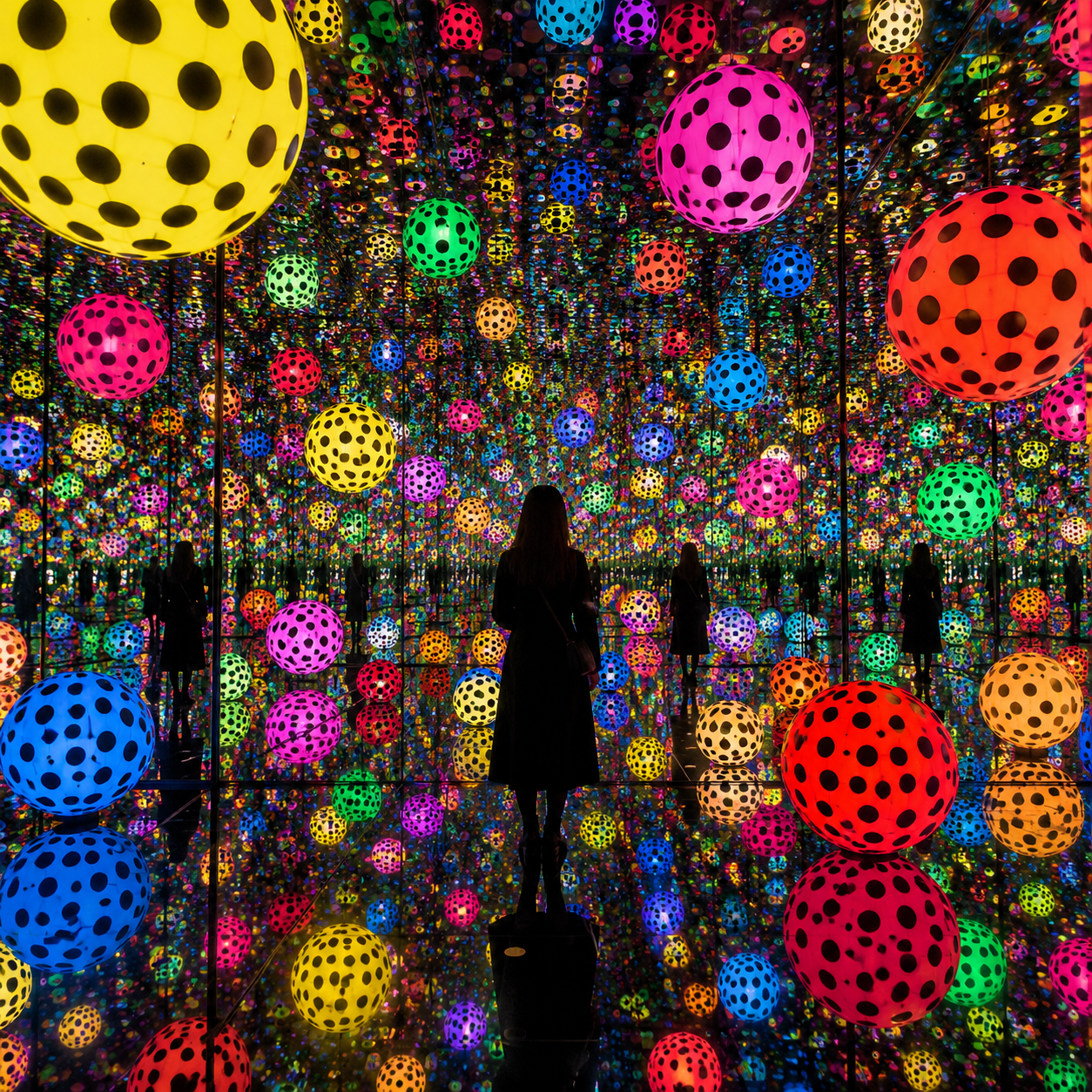
Yayoi Kusama’s Infinity Rooms turn a limited architectural space into an experience that feels immeasurable. Through mirrors, reflected light, repetition, and carefully controlled movement, these installations place visitors inside an artwork rather than in front of one.
The result belongs to both contemporary art and installation art. It is visually immediate, yet it also raises complex questions about identity, scale, perception, and the relationship between an individual and the universe. Understanding how the rooms work can deepen the experience of encountering one, including the opportunity to support an Infinity Mirror Room crowdfunding campaign connected to the Art Gallery of Ontario (AGO).
What Are Yayoi Kusama’s Infinity Rooms?
Yayoi Kusama’s Infinity Rooms are enclosed immersive installations that use mirrors, light, repeated forms, and space to create the perception of an endless environment. Visitors enter the work physically, becoming part of its changing visual composition.
Although the rooms differ in appearance, many rely on a simple architectural transformation: a small or carefully bounded interior appears to extend far beyond its actual walls. Mirrored surfaces reflect points of light, sculptures, or the visitor’s own body. Each reflection becomes another visual event, producing a chain that seems to continue without a clear edge.
This is why the term Infinity Mirror Rooms describes more than a room decorated with mirrors. The installation coordinates materials, illumination, geometry, timing, and audience behavior. Darkness may conceal the physical limits of the space, while small changes in color or brightness give the eye a field of seemingly separate points.
The experience also depends on restriction. A narrow doorway, a limited viewing period, or a compact floor plan can make the room feel more intense. Physical boundaries remain present, but the visual field encourages the mind to imagine what lies beyond them.
The Artistic Vision Behind the Illusion of Infinity
The artistic vision behind Kusama’s Infinity Rooms connects infinity, accumulation, repetition, and self-obliteration with questions about the individual’s place in a vast universe. These themes support multiple interpretations rather than one fixed explanation.
Kusama’s repeated dots, lights, mirrored surfaces, and multiplied objects create accumulation: one element becomes many, and many elements appear to dissolve into an almost limitless field. Repetition can feel orderly, hypnotic, overwhelming, or strangely calming. Its meaning changes with the visitor’s position and emotional response.
Self-obliteration is a useful term for discussing how a figure may seem to lose visual separateness inside a repeated environment. A visitor sees a reflection, then reflections of reflections, until the body appears to merge with the room’s pattern. This does not erase the person literally. Instead, it unsettles the usual distinction between subject and surroundings.
Infinity can also be understood as a tension between the measurable and the imagined. The room has a finite floor, ceiling, and lighting system. The sensation of infinity emerges when those limits become difficult to read. Kusama’s achievement lies in making that perceptual gap emotionally and philosophically productive.
The work should not be reduced to a single biography or psychological interpretation. Its cultural power comes from the way formal decisions, personal symbolism, popular recognition, and the viewer’s own associations meet inside the installation.
The Science of Mirrors, Light, and Perception
The science of Kusama’s Infinity Mirror Rooms depends on repeated reflections, controlled light, darkness, scale, and viewpoint. Together, these factors remove familiar spatial cues and make a finite room appear continuous.
A mirror reflects what is in front of it. When two mirrored surfaces face one another, they can produce a corridor of diminishing reflections. In an installation, strategically placed mirrors multiply lights or objects across several surfaces, creating visual depth that is far greater than the room’s physical depth.
Light provides the room’s visual vocabulary. LEDs or other point sources may appear as isolated stars, floating clusters, or colored signals. Their brightness affects the perceived distance: a sharp point against darkness can seem remote, while a diffuse glow may make the boundary between object and reflection less distinct.
Darkness performs an equally important function. It hides corners, seams, and architectural clues that would otherwise reveal the installation’s dimensions. The eye then relies on incomplete information, and the brain constructs a larger spatial model from repeated patterns.
Perspective matters, too. A visitor standing near the center receives a different composition from someone close to a wall. Reflections change as the body moves, so the room never presents one completely stable image. The installation is therefore a perceptual system, but it remains an artwork rather than a neutral optical demonstration.
Why the Viewer Is Part of the Artwork
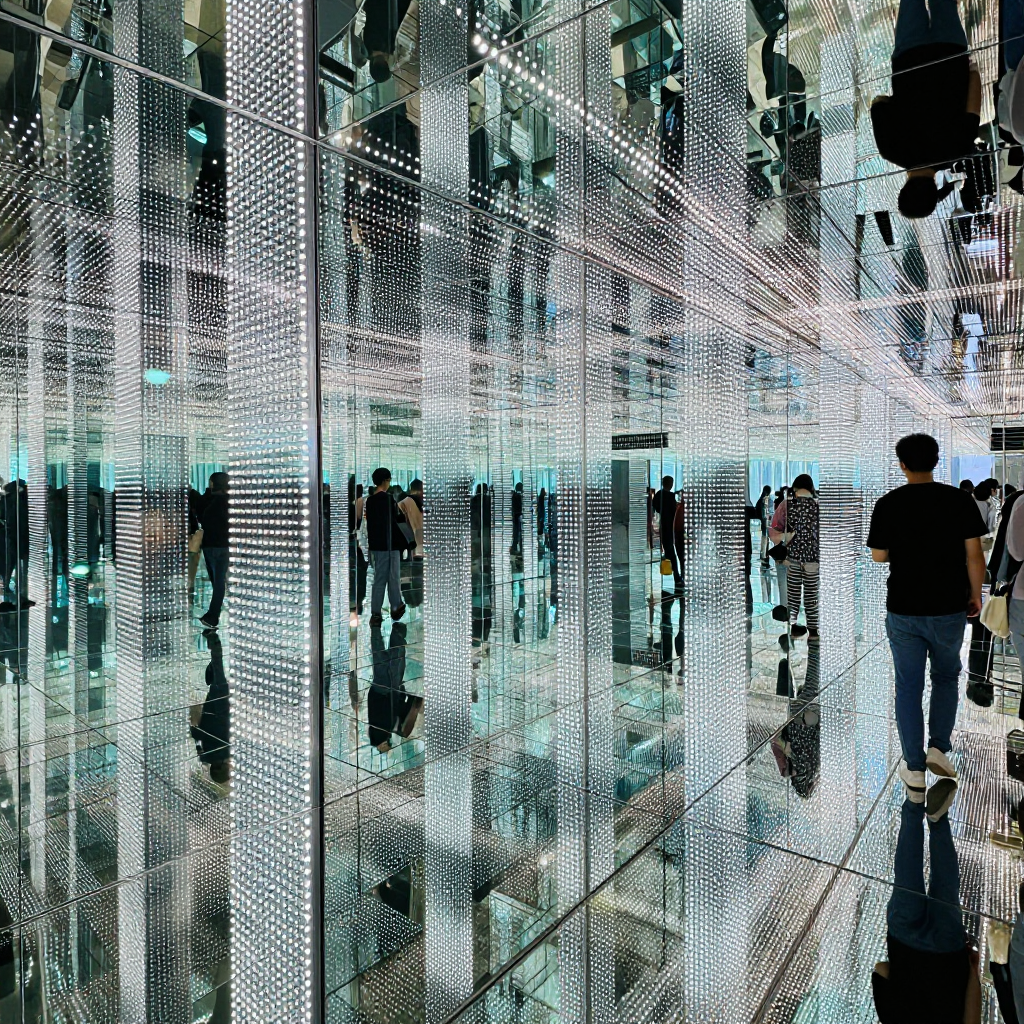
The viewer is part of a Kusama Infinity Room because movement, duration, bodily presence, and interpretation actively shape what the installation reveals. Without a visitor inside, the room remains physically complete but experientially unfinished.
Walking changes the angle of reflection. Turning the head changes the balance of lights and dark areas. Standing still may produce a moment of visual absorption, while moving quickly emphasizes flicker, repetition, and the body’s changing position within the field.
Bodily awareness is central. Mirrors can make a visitor feel expanded, multiplied, displaced, or briefly difficult to locate. The room also makes duration visible: a few seconds can feel compressed, while a longer pause allows patterns and reflections to become more familiar.
Photography adds another layer. A photograph can preserve a striking composition, but it reduces a time-based encounter to a single frame. Screens, camera angles, and visitor limits may also affect how the work is experienced. Taking one considered image, then putting the device away, often leaves more attention for the installation itself.
Audience participation does not mean that every interpretation is equally supported by the work. The room establishes conditions through its construction, lighting, and rules. Within those conditions, each visitor completes a different perceptual and emotional circuit.
From Studio Concept to Museum Installation
Bringing an Infinity Mirror Room from studio concept to museum installation requires coordinated planning for space, lighting, visitor flow, conservation, safety, accessibility, and attentive assembly.
The first task is spatial planning. Curators and designers must assess the room’s footprint, ceiling height, entry and exit points, electrical needs, and relationship to surrounding galleries. A successful installation preserves the intended visual effect while adapting responsibly to the host building.
Lighting must be calibrated rather than treated as decoration. Small changes in intensity, color, timing, or reflection can alter the perceived scale of the room. Technicians may need to test surfaces and sightlines repeatedly before the installation opens.
Visitor flow presents a practical trade-off. Controlled capacity can protect the work and give each person more space, but it may also reduce the number of visitors who can enter at a given time. Clear instructions, timed access, and staff presence help balance access with care.
- Preservation: Mirrors, reflective finishes, wiring, and light sources require inspection and careful cleaning.
- Safety: Routes must account for low light, reflective confusion, trip hazards, emergency access, and supervision.
- Accessibility: Museums should consider mobility, sensory needs, orientation, communication, and alternative ways to engage with the work.
- Installation: Precise alignment and testing are essential because small construction differences can change the visual field.
The physical environment determines who can participate and how comfortably they can do so. That makes installation planning part of the artwork’s public meaning, not merely a backstage concern.
Why an Infinity Mirror Room Matters at the Art Gallery of Ontario
An Infinity Mirror Room at the Art Gallery of Ontario would give audiences a direct encounter with immersive contemporary art while supporting the AGO’s role as a public cultural institution.
Major installation art can be difficult to understand through reproductions alone. A screen shows an image of the room, but it cannot reproduce the changing relationship between body, reflection, darkness, and time. Presenting the work at the AGO would allow visitors to encounter those elements in person and discuss them within a museum setting.
The potential value extends beyond spectacle. An Infinity Mirror Room can prompt conversations about perception, technology, repetition, global contemporary art, and the responsibilities of shared cultural spaces. It can welcome visitors who already know Kusama’s work while giving first-time museum audiences a vivid entry point into installation art.
That accessibility should be paired with interpretation. Wall text, educational programs, staff guidance, and thoughtful visitor policies can help audiences move from an immediate visual reaction toward deeper questions: What does repetition do to attention? When does reflection feel expansive, and when does it feel disorienting? How does a public museum frame an experience designed to challenge ordinary spatial awareness?
Hosting such a work also involves resources and care. The cultural benefit must be matched by responsible planning, transparent fundraising, and a commitment to making access as broad and equitable as possible.
How the Public Can Help Bring the Experience to the AGO
The AGO Infinity Mirror Room crowdfunding campaign gives the public a way to help support the resources needed to bring this kind of immersive contemporary art experience to the museum. Community participation can expand access while connecting supporters directly with a shared cultural goal.
Crowdfunding matters because public participation can complement institutional funding and demonstrate that audiences value ambitious installation art. Contributions may help support exhibition-related costs, visitor access, interpretation, or other campaign priorities. The exact use of funds, benefits, deadlines, and eligibility should always be confirmed through the official AGO campaign information.
Before contributing, review the campaign page carefully. Check its stated purpose, donation terms, tax information, privacy details, and any conditions attached to acknowledgements or rewards. Avoid relying on reposted instructions or unofficial payment links.
Support does not have to mean donating. Sharing the official campaign page, discussing the project, attending related programming, and encouraging accessible museum experiences can also help build informed public interest. A strong campaign depends on clarity: people should understand what they are supporting and why the work matters.
To take part, visit the Art Gallery of Ontario’s official website and follow the verified campaign information for the Infinity Mirror Room. An informed contribution helps connect Kusama’s artistic ideas with the practical work of presenting them to a wider public.
Frequently Asked Questions About Infinity Mirror Rooms
What is an Infinity Mirror Room?
An Infinity Mirror Room is an immersive installation that uses mirrors, light, repeated forms, and enclosed space to create the illusion of an environment extending indefinitely. Visitors enter the artwork and experience it from within.
How does Kusama create the illusion of infinite space?
Kusama creates the illusion through mirrored surfaces, repeated points of light or objects, darkness, controlled viewpoints, and carefully arranged scale. Reflections multiply visible elements while concealed boundaries make the room seem larger than it is.
What makes Infinity Rooms participatory?
Visitors contribute through their physical presence, movement, attention, and interpretation. Each position produces a different arrangement of reflections, so the experience changes from person to person and from moment to moment.
How should visitors experience or photograph an Infinity Room?
Follow museum instructions, move carefully, and allow time to look without a camera. If photography is permitted, take a small number of intentional images without blocking sightlines or distracting other visitors. The photograph records one view; the installation unfolds through presence and duration.
How can I support the AGO’s Infinity Mirror Room crowdfunding campaign?
Use the official Art Gallery of Ontario website to find current campaign details and verified participation instructions. You can donate, share the official campaign, or engage with related AGO programs, depending on the options the campaign provides.
Yayoi Kusama’s Infinity Rooms reward both immediate wonder and patient attention. Their mirrors and lights create the illusion of infinity, while their deeper force comes from the meeting of artistic concept, physical construction, and audience participation. Supporting a transparent crowdfunding campaign for an Infinity Mirror Room at the AGO offers one practical way to help make that encounter available to more people.